
The Craft
A Field Guide to the Weaves
Behind every Parampora saree is a centuries-old tradition. Here are the weaves we cherish — where they come from, and what makes each one unmistakable.
Varanasi, Uttar Pradesh
Banarasi
Woven in the ancient by-lanes of Varanasi, the Banarasi is often called the queen of North Indian silks. Its signature is brocade — gold and silver zari woven directly into luminous mulberry silk, never printed or stitched on, so the shimmer is permanent and doesn't fade with wear.
The motifs trace back to Mughal ateliers: floral jaals, paisleys, kalga-bel vines, and jharokha patterns. Master weavers use the kadwa technique, where each motif is woven individually with no loose threads at the back — slower, harder, and unmistakably finer. A single saree can spend 15 to 30 days on the loom, and heavily brocaded bridal pieces far longer.
How to know it's real: gently scratch the zari — pure zari reveals a reddish silk core. Turn the saree over; a genuine handwoven Banarasi shows neat floats of thread, the quiet signature of the human hand.
Kanchipuram, Tamil Nadu
Kanjivaram
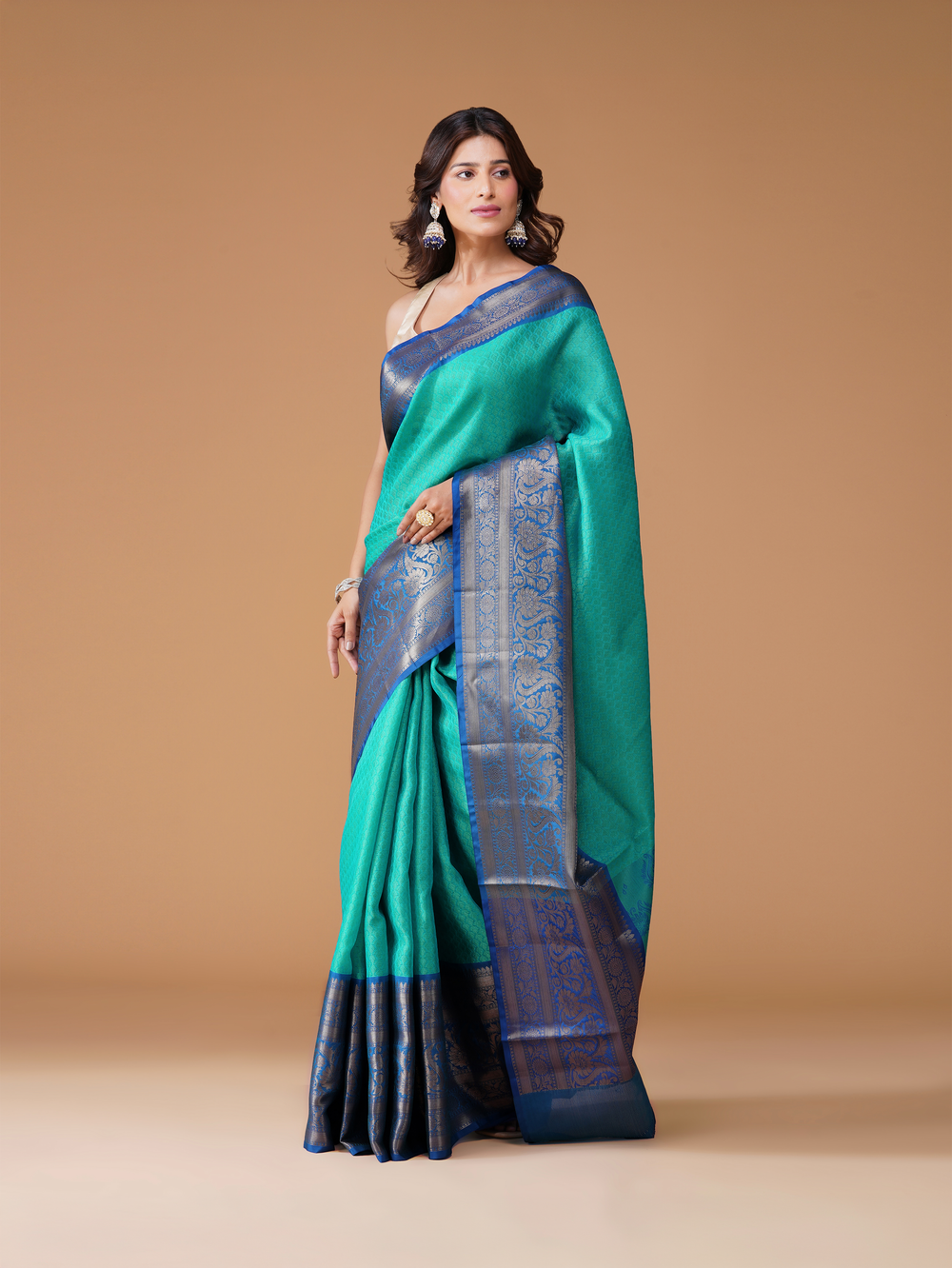
From the temple town of Kanchipuram comes the most substantial silk saree in India. A true Kanjivaram is woven from three-ply mulberry silk — thick, structured, with a fall that announces itself — and borders dipped in gold and silver zari.
What sets it apart is the korvai technique: the border and body are woven separately, often in bold contrasting colours, and then interlocked so firmly that even if the saree were to tear, the border would not detach. Two weavers work the loom together with three shuttles, one from each side — a duet that has continued for generations since the Chola era.
Temple borders, checks, and motifs drawn from Dravidian architecture make the Kanjivaram the definitive bridal and ceremonial saree of the South — an heirloom by design, meant to outlive its first owner.
Mysuru, Karnataka
Mysore Silk
If the Banarasi is ornate and the Kanjivaram regal, the Mysore silk is pure understatement. Woven from some of the finest mulberry silk in the country — Karnataka produces the bulk of India's mulberry silk — it is known for a smooth, glassy finish, a lightweight drape, and minimal, elegant zari work.
Its lustre comes from the quality of the silk itself rather than heavy ornamentation, which is why a Mysore silk moves like liquid and resists creasing through a full day of wear. Solid jewel tones with a slim gold border are its classic language.
Perfect for the woman who wants unmistakable silk without the weight — offices, pujas, daytime ceremonies, and everywhere in between.
Bengal
Jamdani
Recognised by UNESCO as an Intangible Cultural Heritage of Humanity, Jamdani is perhaps the most painstaking weave in the subcontinent. On a fine muslin base, weavers add each motif by hand with a supplementary weft — flowers, birds, and vines that appear to float, suspended in near-transparent fabric.
There is no printed pattern to follow; the design lives in the weaver's memory and emerges thread by thread. A fine Jamdani can take months, and no two pieces are ever identical.
Feather-light and breathable, it is the summer silk-lover's answer — airy enough for a Kolkata afternoon, intricate enough for an evening celebration.
Bengal
Tant & Bengal Handloom
The everyday genius of Bengal. Tant sarees are woven from crisp, fine cotton with light, airy bodies and distinctive thick borders — built for heat, humidity, and the rhythm of daily life. Starched and pleated, a Tant holds its shape from morning to night.
Alongside Tant, Bengal's looms produce soft dhakai-inspired weaves and cotton-silk blends that carry the region's love of red-and-white palettes, fish and lotus motifs, and borders that tell stories.
These are the sarees women live in — unpretentious, comfortable, and quietly beautiful, passed from mother to daughter not as treasure locked away, but as something worn and loved daily.