

October 02, 2026
Types of Silk Sarees in India: 20+ Weaves and Buying Guide
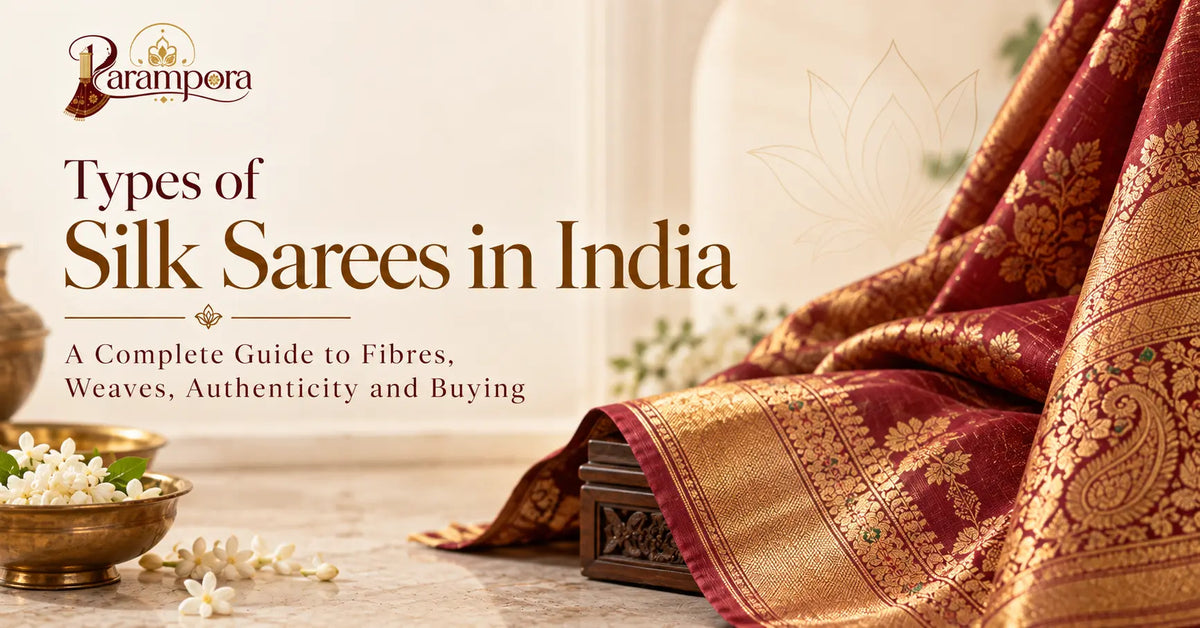
Types of Silk Sarees in India: A Complete Guide to Fibres, Weaves, Authenticity and Buying
India does not have one kind of silk saree. It has dozens. Each one is shaped by its fibre, its region, its loom, its motifs and the community that weaves it.
A Kanjivaram and a Banarasi may both be sold as "silk sarees", yet they are woven differently, fall differently and carry entirely different design languages. That gap between a name and the actual textile is where most online buying mistakes happen.
This guide covers the types of silk sarees in India in full. It explains the silk fibres, more than twenty regional weaves, how to read a product label, how to spot pure silk, and how to buy online with confidence. Where it helps, we point to examples from our own handloom saree collection so you can see the ideas in real fabric.
Quick answer: what are the main types of silk sarees in India?
The best-known types are Kanchipuram (Kanjivaram), Banarasi, Paithani, Mysore silk, Patola, Baluchari, Pochampally ikat, Gadwal, Dharmavaram, Chanderi, Maheshwari, Tussar (Tasar), Uppada Jamdani, Sambalpuri and Bomkai, and the Muga, Eri and Pat silks of Assam. "Silk" names the fibre. The other names describe a regional weaving tradition, so always check the fibre composition separately.
What Is a Silk Saree? Fibre, Weave, Design and Craftsmanship Explained
A silk saree is made wholly or partly from silk, a natural protein fibre produced by certain silkworms. The Silk Mark Organisation of India identifies Mulberry, Tasar, Eri and Muga as the major silk varieties produced in India.
But "silk saree" is a broader label than it first appears. Before buying, ask two separate questions:
-
What is the fibre? Is it Mulberry, Tasar, Eri, Muga or a blend?
-
What is the weaving tradition? Is it Kanchipuram, Banarasi, Paithani or Patola?
Mulberry silk is a fibre category. Kanchipuram is a regional silk-weaving tradition. Banarasi is a textile tradition associated with Varanasi. Paithani belongs to Maharashtra. These are different kinds of information, and a good buying decision needs both.
The four layers of every silk saree
A simple way to judge any silk saree is to look at four layers in this order:
Fibre → Weave → Design → Craftsmanship
-
Fibre shapes lustre, handle and how the saree takes colour.
-
Weave is how threads are constructed into cloth: the loom, the technique and the structure.
-
Design covers motifs, border, pallu and colour.
-
Craftsmanship is the skill, finishing and time put into the piece.
Two sarees can share a colour and a price yet differ completely on weave and workmanship. That is why comparing silk sarees by photograph alone can mislead.
Silk fibre vs silk weave: the distinction that prevents costly mistakes
A saree's name does not always tell you its fibre. Here is how the common terms differ:
-
Kanchipuram describes a regional weaving tradition.
-
Banarasi describes a textile tradition associated with Varanasi.
-
Mulberry silk describes the fibre.
-
Zari describes metallic thread used for ornamentation.
-
Handloom describes the method of weaving.
-
Jamdani, ikat and bandhani describe techniques that can appear on different fibres.
The Silk Mark Organisation of India advises consumers that silk can be hard to identify by look and feel alone. So read the material and construction details the seller supplies, not just the product title.
Types of Silk Fibre Used in Indian Sarees: Mulberry, Tussar, Eri, Muga and Pat
Before the regional names, understand the raw material. India produces all four major commercial silks.
Mulberry Silk
Mulberry silk comes from silkworms fed on mulberry leaves and is the most widely produced silk in India. It is prized for its smooth surface, lustre and excellent colour uptake. Many of the best-known traditions, including Kanchipuram, Mysore and many Banarasi sarees, use it.
Buyer's note: the word "silk" in a saree name does not prove the saree is entirely silk. Always read the stated fibre composition.
Tasar (Tussar) Silk
Tasar, written both "Tasar" and "Tussar" in the trade, is a wild silk. It usually has a more textured, slightly matte, earthy surface than mulberry silk, which is why it carries embroidery and cutwork so well. It is produced across eastern and central India and appears in many regional handloom traditions.
To see tussar in practice, look at our Mauve Pure Tussar Silk Saree with Gold Buti Embroidery, the Emerald Green Pure Tussar Silk Saree with Blue Paisley Embroidery or the textured Rust Brown Pure Handloom Tussar Gheecha Silk Saree with Hand Cutwork.
Eri Silk
Eri silk is closely associated with Assam and other parts of Northeast India. It has a soft, dense, wool-like feel. It is sometimes called "peace silk" in popular discussion, but production practices and terminology vary. A seller using that phrase should explain exactly what it means rather than using it as a blanket quality claim.
Muga Silk
Muga is native to Assam and known for its naturally golden sheen. It is among the most distinctive and regionally protected silks in India, and is traditionally linked with Assamese ceremonial wear.
Pat Silk
Pat is the Assamese name for silk reared on mulberry. It is smooth and lustrous and used for festive and ceremonial Assamese textiles. It is a mulberry silk with its own regional name.
Silk Fibres Compared
|
Silk type |
Associated regions |
Typical character |
|
Mulberry |
Karnataka, Tamil Nadu, Andhra Pradesh, West Bengal, Assam (as Pat) and others |
Smooth, lustrous, takes colour richly |
|
Tasar / Tussar |
Jharkhand, Chhattisgarh, Odisha, Bihar, West Bengal and nearby |
Textured, natural, slightly matte |
|
Eri |
Assam and Northeast India |
Soft, dense, wool-like handle |
|
Muga |
Assam |
Naturally golden, highly regional |
Muga, Eri, Tasar and Mulberry are different silks and should never be treated as interchangeable words.
Types of Silk Sarees in India at a Glance
Use this table to get your bearings. Each weave is explained in detail below.
|
Saree |
Region |
Usual fibre |
Known for |
Often worn for |
|
Kanchipuram (Kanjivaram) |
Tamil Nadu |
Mulberry silk |
Korvai borders, temple motifs, structured fall |
Weddings, ceremonies |
|
Banarasi |
Uttar Pradesh |
Silk, several constructions |
Zari brocade, jaal, Mughal-inspired motifs |
Weddings, festivals, receptions |
|
Paithani |
Maharashtra |
Silk |
Peacock and lotus motifs, rich pallu |
Weddings, heirloom wear |
|
Mysore silk |
Karnataka |
Mulberry silk |
Smooth finish, restrained zari |
Festive, formal, daytime |
|
Patola |
Gujarat |
Silk |
Double ikat, geometric precision |
Weddings, collectors |
|
Pochampally ikat |
Telangana |
Silk, cotton, silk-cotton |
Ikat geometry, bold colour |
Festive, work, daily |
|
Gadwal |
Telangana |
Silk-cotton |
Interlocked weft, silk border and pallu |
Festive, ceremonial |
|
Dharmavaram |
Andhra Pradesh |
Silk |
Broad borders, rich colours |
Weddings, festivals |
|
Uppada Jamdani |
Andhra Pradesh |
Silk |
Light weight, jamdani motifs |
Festive, evening |
|
Ilkal |
Karnataka |
Cotton with silk or art-silk pallu |
Distinct pallu join, bold borders |
Festive, daily |
|
Chanderi |
Madhya Pradesh |
Silk, cotton, silk-cotton |
Sheer texture, delicate motifs |
Daytime, festive |
|
Maheshwari |
Madhya Pradesh |
Silk-cotton, silk |
Light drape, distinctive borders |
Office, puja, festive |
|
Tussar / Kosa |
Eastern and central India |
Tasar silk |
Textured, earthy, artisanal |
Festive, work, gifting |
|
Baluchari |
West Bengal |
Silk |
Narrative pallu with figures |
Weddings, collectors |
|
Garad / Korial |
West Bengal |
Silk |
Off-white body, contrast border |
Pujas, ceremonies |
|
Sambalpuri and Bomkai |
Odisha |
Silk and cotton |
Bandha ikat, Bomkai motifs |
Festive, daily |
|
Muga, Eri, Pat |
Assam |
Muga, Eri, Mulberry |
Golden, soft and lustrous varieties |
Ceremonial, festive |
|
Bhagalpuri |
Bihar |
Tasar and other silks |
Soft, textured silks |
Daily, festive |
|
Kota Doria |
Rajasthan |
Cotton and silk |
Square-check texture, very light |
Summer, daytime |
|
Bandhani and Gharchola |
Gujarat, Rajasthan |
Silk, georgette and others |
Tie-dyed dots, grid patterns |
Weddings, festivals |
South Indian Silk Sarees: Kanjivaram, Mysore, Dharmavaram, Gadwal and More
South India is the heartland of the ceremonial silk saree. The tradition favours substantial fabric, strong colour contrast and temple-inspired design.
Kanchipuram (Kanjivaram) Silk Sarees
Region: Kanchipuram, Tamil Nadu. Known for: structured silk, contrasting borders, zari and temple motifs.
Kanchipuram sarees are among India's most recognisable bridal and ceremonial textiles, and "Kancheepuram Silk" holds Geographical Indication (GI) registration. The traditional saree is woven in mulberry silk, and its identity rests on construction as much as on appearance.
The key technique is korvai: the body and border are woven separately, often in bold contrasting colours, and then interlocked so firmly that the border resists detaching. The India Handloom Brand's technical documentation also refers to petni, used for contrasting pallus. In the traditional method, two weavers sit at one loom and work the shuttles together.
Typical design vocabulary includes temple borders, checks (kattam), stripes and motifs drawn from regional art and architecture. Kanjivaram is the classic South Indian wedding and ceremonial saree.
What to check: fibre composition, korvai construction, zari details, provenance and any documentation. To see how the craft works, read our guide to Indian handloom weaves.
Kanchipuram and Kanjivaram are two names for the same tradition.
Mysore Silk Sarees
Region: Karnataka. Known for: smooth silk, light drape and restrained zari.
Mysore silk carries GI registration and is admired for its soft, smooth handle. Its beauty comes from the quality of the silk rather than heavy ornament, which is why classic Mysore sarees tend to be solid jewel tones with a slim zari border. They suit people who want unmistakable silk without the weight of a bridal Kanjivaram: festive days, formal events, pujas and daytime ceremonies.
What to check: the stated fibre and zari, not just the "Mysore silk" name.
Dharmavaram Silk Sarees
Region: Dharmavaram, Andhra Pradesh. Known for: broad zari borders, strong colours and ceremonial presence.
Dharmavaram silk sarees hold GI registration and are closely tied to South Indian wedding and festive dressing. They are recognised for rich colour pairings, generous borders and richly decorated pallus.
Gadwal Sarees
Region: Gadwal, Telangana. Known for: a cotton body joined to a silk border and pallu, using an interlocked-weft technique.
Gadwal shows why a regional name does not guarantee pure silk. The tradition is known for a silk-cotton construction in which a lighter cotton body carries a silk border and pallu. The result has festive richness and everyday wearability.
Pochampally Ikat Sarees
Region: Pochampally, Telangana. Known for: ikat patterning and bold geometric colour.
Pochampally ikat holds GI registration. In ikat, yarns are tied and resist-dyed before weaving, so the pattern emerges from the arrangement of dyed threads rather than being printed onto finished cloth. Pochampally is woven in silk, cotton and silk-cotton, so confirm the fibre on each piece.
Our Cream Semi Raw Silk Saree with Teal Ikat Temple Border shows how ikat can sit alongside a temple-style border.
Uppada Jamdani Sarees
Region: Uppada, Andhra Pradesh. Known for: lightweight silk with jamdani-style woven motifs.
Uppada Jamdani is a GI-registered tradition known for its light weight and floating, hand-inserted motifs. It is a useful reminder that jamdani is a technique, not a fibre. The supplementary-weft method appears in silk in Uppada and in cotton in Bengal. You can see the cotton side in our Yellow Tant Jamdani Handloom Saree with Blue Weaving.
Ilkal Sarees
Region: Ilkal, Karnataka. Known for: a cotton body, a silk or art-silk pallu and a distinctive way of joining the two.
Ilkal also holds GI registration. The body and pallu are joined with a looping technique that gives the saree a recognisable construction. It sits between everyday cotton and festive silk, and the pallu fibre is the thing to confirm before buying.
Western Indian Silk Sarees: Paithani, Patola and Bandhani
Paithani Sarees
Region: Paithan and Yeola, Maharashtra. Known for: silk, peacock and lotus motifs, tapestry-like weaving and a lavish pallu.
Paithani holds GI registration and is one of Maharashtra's most treasured textiles. Its look comes from silk, rich colour and a woven motif vocabulary of peacocks, flowers and vines, with the pallu as the star. Because the motifs are woven in with a tapestry-style technique rather than added later, a genuine Paithani is labour-intensive, and the price reflects the time.
Patola Sarees
Region: Patan, Gujarat. Known for: double ikat and geometric precision.
Patan Patola is GI-registered and considered one of India's most technically demanding textiles. In double ikat, both warp and weft yarns are resist-dyed in advance so the design aligns exactly when woven. The precision is the point.
Traditional Patan Patola is expensive because of the skill and time involved. A simpler single-ikat Patola is also woven in Rajkot, so confirm the type and provenance of any "Patola" you are shown. A very low price for a "double ikat Patola" is a signal to ask questions.
Bandhani and Gharchola Sarees
Region: Gujarat and Rajasthan. Known for: tie-dyed dot patterns on silk, georgette and other fabrics.
Bandhani, also called Bandhej, is a tie-dye craft in which tiny points of cloth are bound before dyeing, leaving dot patterns. Gharchola is a traditional Gujarati wedding saree with a grid-like arrangement of bandhani squares. Both are bridal and festive favourites, particularly for Navratri and weddings.
Bandhani is a technique, not a fibre, so it appears on different fabrics. Our Rani Pink Bandhej Pure Georgette Chiffon Saree with Cutdana Border is a georgette-chiffon example.
Central Indian Silk Sarees: Chanderi, Maheshwari, Kosa and Tussar
Chanderi Silk Sarees
Region: Chanderi, Madhya Pradesh. Known for: lightness, a sheer texture and delicate motifs.
Chanderi is GI-registered and woven in silk, cotton and silk-cotton constructions. A saree called Chanderi is therefore not automatically pure silk. Its airy quality makes it a favourite for daytime functions and warm weather.
Maheshwari Silk and Silk-Cotton Sarees
Region: Maheshwar, Madhya Pradesh. Known for: light drape, distinctive borders and silk-cotton blends.
Maheshwari sarees come in silk and silk-cotton and are appreciated for being lighter and more versatile than a heavy ceremonial silk. The borders often feature small woven patterns and are a hallmark of the weave. Our Green Maheshwari Handloom Cotton Silk Saree with Zari Border shows the silk-cotton character clearly.
Kosa Silk Sarees
Region: Chhattisgarh. Known for: tasar-family silk with a natural, earthy texture.
Kosa is a tasar-family silk associated with Chhattisgarh. It shares the grainy, matte appeal of tussar, which suits those who prefer a natural look over a high-sheen finish.
Tussar Silk Sarees, Including Bhagalpuri and Ghicha
Region: Jharkhand, Chhattisgarh, Odisha, Bihar and West Bengal. Known for: natural texture and artisanal surface work.
Tussar is both a fibre and a saree category. The base cloth is textured and slightly matte, which is why it carries embroidery, cutwork and hand-painting so well. Bhagalpur in Bihar is a long-standing centre for tasar and other silks.
Two terms you may see on listings:
-
Ghicha (Gheecha): a tussar yarn that gives a rougher, nubby surface.
-
Semi tussar: generally indicates a blend rather than pure tussar, so read the fibre line carefully. Our Black Semi Tussar Silk Saree with Gold Striped Pallu is an example of this category.
For pure tussar with fine hand embroidery, see the Ivory Pure Tussar Silk Floral Embroidery Saree.
Eastern and Northeastern Silk Sarees: Baluchari, Garad, Sambalpuri and Assam Silks
Baluchari and Swarnachari Sarees
Region: Bishnupur and Murshidabad, West Bengal. Known for: narrative pallus with figures and scenes.
Baluchari is GI-registered and is among the most fascinating examples of textile storytelling in India. The pallu can depict figures, courtly scenes and stories, so the interest lies in what is woven as much as in the silk itself. Swarnachari is a variation that uses gold-coloured zari. For many buyers a Baluchari is closer to a woven artwork than a conventional saree.
Garad, Korial and Kantha Silk Sarees
Region: West Bengal. Known for: understated silks used in rituals and festivals.
Garad (also spelt Korial) is a traditional Bengali silk, typically off-white or cream with a contrasting border, and is closely tied to pujas and ceremonies. Kantha silk sarees are hand-stitched with running-stitch embroidery in rich patterns. Bengal's wider loom heritage also includes light cotton and cotton-silk weaves, which you can explore in our handloom weave guide.
Sambalpuri and Bomkai Sarees
Region: Odisha. Known for: bandha (ikat) patterns and the Bomkai motif tradition.
Sambalpuri ikat and Bomkai both hold GI registration. Sambalpuri is woven in cotton and in silk, so the fibre must be confirmed on each piece. Bomkai is known for its woven motifs and comes in silk and cotton variants. Our Grey Sambalpuri Kotki Pure Khadi Cotton Handloom Saree is a cotton example of the ikat, a good reminder that a weave name does not guarantee silk.
Muga Silk Sarees (Assam)
Muga is a GI-registered silk of Assam, known for its natural golden sheen, which is often said to deepen with use. It is among the most culturally significant Assamese textiles and is traditionally worn on ceremonial occasions. Assam's most traditional women's garment is the mekhela chador, a two-piece wrap related to but distinct from the saree.
Eri Silk Sarees (Assam)
Eri is soft, dense and warm, closer to wool in feel than to lustrous mulberry silk. It is valued for comfort and used for shawls and stoles as well as sarees. Ask sellers to explain any "peace silk" claim, as the term is used loosely.
Pat Silk Sarees (Assam)
Pat is Assam's mulberry silk: smooth, lustrous and often woven with traditional Assamese motifs for festive wear and weddings.
Northern Silk Sarees: Banarasi, Kota Doria and Jamdani
Banarasi Silk Sarees
Region: Varanasi, Uttar Pradesh. Known for: brocade, zari, jaal designs and elaborate pallus.
"Banaras Brocades and Sarees" hold GI registration. The tradition draws on Mughal-era design: floral jaals, paisleys, butis, kalga-bel vines and jharokha-style arches. Motifs are woven into the fabric rather than printed, so the design is part of the cloth.
A common method is kadhua (kadwa), in which each motif is woven individually without carrying thread across the back. It is slower and finer. A simple Banarasi can take days on the loom, while a heavily brocaded bridal piece can take weeks or months.
"Banarasi" is not one product but a family of constructions, which the next section explains. Browse our full Banarasi saree collection to see the range.
Kota Doria Sarees
Region: Kota and Kaithoon, Rajasthan. Known for: featherlight cotton-silk cloth with a square-check texture.
Kota Doria is woven from cotton and silk and prized in hot weather. The checked "khat" texture is its signature, and it is a sensible choice for summer, daytime and office wear.
Jamdani Silk Sarees
Jamdani is a hand-inserted supplementary-weft technique that makes motifs look as though they float on the fabric. It is associated with Bengal and, in silk, with Uppada in Andhra Pradesh. Jamdani names the technique, not the fibre.
Types of Banarasi Sarees: Katan, Organza, Georgette, Tissue and Tanchoi
This is one of the biggest gaps in most silk saree guides. Banarasi describes a tradition, and the fabric underneath can be quite different. Here are the main constructions you will see.
Katan Banarasi
Katan is a plain-weave silk made from twisted silk yarn. It has a soft, substantial feel and is the base for many classic brocade sarees. Our Ivory Katan Silk Saree with Red and Yellow Paisley Embroidery shows katan with paisley detailing.
Organza (Kora) Banarasi
Organza, often called kora in the trade, is sheer and crisp. It carries zari motifs lightly and suits those who want Banarasi elegance without heavy drape. See the Royal Blue Organza Silk Banarasi Saree with Silver Zari.
Georgette Banarasi
Georgette uses crepe-twisted yarn and falls fluidly. It is lighter than katan and easier to carry for long events. Our Rani Pink Banarasi Dyeable Georgette Saree with Zari Meenakari Buta and Black Banarasi Dyeable Georgette Silk Saree with Meenakari Jaal Weaving are examples. Always check the listing for the exact fibre of a georgette.
Tissue Banarasi
Tissue sarees use metallic weft threads, giving the cloth a light, shimmering sheen. Our Maroon Zari Tissue Saree with Zig-Zag Weave shows the effect.
Tanchoi (Tanchui) Banarasi
Tanchoi, also spelt Tanchui, is a fine, self-toned weave in which small motifs appear through extra weft threads in a satin-type structure. The effect is subtle and tone-on-tone with a little zari accent. Browse the Yellow Banarasi Tanchui Silk Saree with Pink Zari Buta Border, the Mehendi Green Banarasi Tanchui Silk Saree and the Sea Green Banarasi Tanchui Silk Saree. If you are working to a budget, our sarees under ₹2,500 are a good place to start.
Resham Banarasi
Resham means silk thread. A resham Banarasi uses silk yarn for the motif work as well as the base, creating a rich, soft look. See the Rani Pink Pure Resham Banarasi Saree with Zari Border.
Banarasi terms you will meet
-
Meenakari: coloured silk threads woven in to resemble enamel work.
-
Jangla: dense all-over vine-and-flower patterns.
-
Cutwork: the extra-weft motif has its back floats trimmed away, giving a lighter, more affordable cloth than kadhua weaving.
-
Shattir: a lighter Banarasi variety, often with smaller motifs or stripes.
-
Dyeable: in the trade this usually means the base fabric can take a different dye shade. Confirm exactly what it means with the seller.
Types of Zari in Silk Sarees: Pure, Tested and Imitation
Zari is the metallic thread that gives silk sarees their glow, and it is one of the biggest drivers of both price and durability. Traditionally, zari is a fine silver strip or wire, often gold-plated, wound around a silk core.
Terms vary between sellers, but you will commonly see three grades:
|
Zari type |
What it usually means |
What to expect |
|
Pure or real zari |
Silver (often gold-plated) metal over a silk core |
Heavier, longer-lasting, more expensive |
|
Tested zari |
Zari tested to contain a stated silver content |
Mid-range, with a lower metal content than pure |
|
Imitation or metallic zari |
Plated copper or coated synthetic thread |
Lightweight and affordable, may tarnish sooner |
Two facts to hold onto:
-
Silk Mark does not certify zari. The organisation states that its label covers the silk, not the zari's purity or quality.
-
Ask for specifics. A reliable seller will state the zari type and, where relevant, the metal content.
Kanjivaram vs Banarasi: Key Differences
These are the two sarees buyers compare most. The comparison below is general, since individual pieces vary.
|
Feature |
Kanjivaram (Kanchipuram) |
Banarasi |
|
Region |
Kanchipuram, Tamil Nadu |
Varanasi, Uttar Pradesh |
|
GI status |
Registered ("Kancheepuram Silk") |
Registered ("Banaras Brocades and Sarees") |
|
Usual fibre |
Mulberry silk |
Silk in several constructions (katan, organza, georgette, tissue and others) |
|
Signature technique |
Korvai border interlocking, petni pallu |
Kadhua brocade, cutwork, tanchoi, meenakari |
|
Typical look |
Bold colour contrast, temple borders, checks |
Floral jaal, paisley, Mughal-inspired motifs |
|
Typical feel |
Structured, substantial |
Ranges from sheer organza to rich brocade |
|
Common occasions |
Weddings, ceremonies |
Weddings, festivals, receptions |
Which should you choose? If you want a structured, high-contrast ceremonial saree rooted in South Indian tradition, Kanjivaram is the classic. If you want a wider range of weight and finish, from sheer to heavily brocaded, Banarasi offers more variety.
Best Silk Saree for Weddings, Festivals, Office and Summer
There is no single best silk saree. The right one depends on what you need from it.
|
Occasion or need |
Silk sarees to consider |
Why |
|
Traditional wedding |
Kanjivaram, Banarasi, Paithani, Dharmavaram |
Rich zari, structure and ceremonial heritage |
|
Bridal trousseau or heirloom |
Kanjivaram, Paithani, Patola, Baluchari |
Labour-intensive weaves that hold value |
|
Festive evenings and receptions |
Banarasi organza, tissue, Uppada Jamdani |
Glow without heavy weight |
|
Daytime pujas and family functions |
Mysore silk, Chanderi, Maheshwari, tanchoi |
Lighter and easier to wear |
|
Office and formal wear |
Tussar, Maheshwari, Kota Doria, Mysore silk |
Understated texture and manageable weight |
|
Summer and humid weather |
Kota Doria, Chanderi, Uppada Jamdani, silk-cotton |
Light, breathable constructions |
|
Navratri and Garba |
Bandhani, Gharchola, tissue |
Bright colour and festive character |
|
Gifting |
Tussar, tanchoi Banarasi, Maheshwari |
Distinctive yet versatile |
|
Collectors |
Patola, Baluchari, Paithani, Muga |
Technique and provenance matter most |
For a first silk saree, a lighter option such as tussar, tanchoi or silk-cotton is easier to wear often and easier to care for. If you are shopping by price, browse our sarees under ₹5,000 or under ₹10,000, or see what is new this week and customer favourites.
How to Identify a Pure Silk Saree
Online buyers should be especially careful here. The Silk Mark Organisation of India states that it is very difficult to identify silk by look and feel alone, so avoid relying on advice like "feel it and you will know". Use several forms of evidence instead.
1. Check the Fibre Composition
Read the product description for clear terms such as pure silk, Mulberry silk, Tussar silk, silk-cotton, silk blend, art silk, or polyester. Do not assume "silk saree" means 100% silk.
2. Look for the Silk Mark Label
The Silk Mark label is used on 100% pure silk products by authorised users of the Silk Mark system, and the organisation states that it carries authentication features including a hologram and a unique number. It establishes the purity of the silk component. It does not certify zari.
3. Check for Handloom Mark and GI Information
The India Handloom Brand and the Handloom Mark indicate handloom production, and the Geographical Indication tag identifies regional origin for traditions such as Kanchipuram, Banarasi, Paithani and Chanderi. These do not replace fibre checks, but they add useful evidence. Verify any GI claim against the official registry for the specific product.
4. Ask About the Weave
If a saree is sold as a regional handloom tradition, ask what construction gives it that identity. For Kanchipuram, for example, the documentation refers to korvai and petni.
5. Understand the Burn Test, and Its Limits
You may hear that silk burns slowly with a smell like burnt hair and leaves crushable ash, while synthetics melt into a hard bead. That is a commonly cited rule of thumb, but it has real limits. It can mislead on blends and treated yarns, and you should never do it on the saree itself. Treat it as a clue only, and prefer documentation for valuable purchases.
6. Watch for Red Flags
-
No fibre composition stated, or vague words such as "silk finish" or "silk touch".
-
A price far below what comparable handloom work costs.
-
"Pure silk" claimed with no certification, provenance or return policy.
-
Close-up photographs missing for the border, pallu and zari.
How to Read Silk Saree Labels: Pure Silk, Semi Silk, Art Silk and Blends
Many buyer complaints come from not knowing what the label really says. Here is a plain-English decoder.
|
Label term |
What it generally means |
|
Pure silk |
Made from silk fibre. Ask which silk and whether certified |
|
Mulberry silk |
Silk from mulberry-fed silkworms |
|
Tussar or Tasar silk |
Wild silk with a textured surface |
|
Semi silk or semi tussar |
Typically a blend. Read the stated composition |
|
Silk-cotton |
Silk combined with cotton for lighter weight and breathability |
|
Art silk |
Artificial or synthetic fibre made to look like silk. Not natural silk |
|
Silk blend |
Silk mixed with other fibres. Check the proportions |
|
Bamboo jute silk |
A blend that mixes silk with other fibres. Check the listing |
|
Handloom |
Woven on a hand-operated loom |
A blend is not automatically a bad product. Silk-cotton, for instance, is a respected tradition. The issue arises only when a blend is sold as pure silk. Our Mauve Bamboo Jute Silk Saree with Silver Star Embroidery is one example of a blended fabric, so always read the composition line on every listing.
Handloom vs Powerloom vs Machine-Made Sarees
These terms describe how the fabric is produced.
-
Handloom: woven on a hand-operated loom by a weaver. Labour intensive, and often slightly individual in finish.
-
Powerloom: woven on mechanised looms, which is faster and typically cheaper.
-
Machine-made: a broad category covering varying degrees of automation.
Do not assume that an expensive-looking saree is handwoven. If handloom provenance matters to you, ask the seller to state it clearly and explain how it can be verified. Minor variations in weave, shade or zari in a handloom saree are normal and reflect the human hand rather than a defect.
What Decides the Price of a Silk Saree?
There is no single price that makes a saree "genuine". These factors drive the price:
-
Fibre: pure silk and blends differ widely in cost.
-
Weaving technique: a more intricate construction takes more skill and time.
-
Handloom vs other production: hand weaving is labour intensive.
-
Zari: type, quantity and quality of zari change the price.
-
Motif complexity: dense brocade and elaborate pallus take more weaving effort.
-
Artisan workmanship: skilled hand weaving commands a premium.
-
Provenance: established regional traditions can influence value.
-
Finishing: the quality of edges, fall and blouse piece matters.
This is why comparing two sarees purely by colour and price can mislead. A lower price may reflect a lighter weave, a blend, less zari or a different production method, and that can be perfectly fair if it is stated honestly.
How to Buy a Silk Saree Online: A 10-Point Checklist
Buying silk online gets easier when you know what to look for. Before you pay, check:
-
Material: what fibre is it made from?
-
Weave: what regional or technical tradition does it represent?
-
Origin: where is it woven or sourced?
-
Zari: what type is used?
-
Construction: is it handwoven, powerloom or something else?
-
Certification: is Silk Mark, Handloom Mark or a GI reference available?
-
Measurements: check saree length, width and blouse-piece details.
-
Care: how should it be cleaned and stored?
-
Photographs: are there close-ups of the body, border, pallu and zari?
-
Policies: read the return and exchange policy and shipping policy before you buy.
A transparent seller makes all of this easy to find. For quick answers on delivery, returns and care, see our FAQs.
How to Care for and Store a Silk Saree
Silk is a delicate textile. Start with the care instructions supplied with your specific saree.
-
Avoid unnecessary washing, and use professional dry cleaning for zari silks.
-
Keep the saree away from prolonged direct sunlight.
-
Store in a clean, dry place, wrapped in muslin or soft cotton rather than plastic.
-
Avoid compressing heavily embellished sarees.
-
Refold stored sarees every few months so the same fold lines are not kept for years.
-
Protect zari from moisture and avoid spraying perfume directly onto the fabric.
-
Do not try household stain removers on an expensive saree.
The Silk Mark Organisation's consumer guidance notes that a silk saree can last for generations when properly cared for.
Why Buying Silk Sarees Directly From Weavers Matters
Behind every weave in this guide is a family and a skill that has been passed down. When a saree reaches you through several middlemen, the weaver's share shrinks and the story behind the cloth gets lost.
Parampora works the other way around. We source straight from handloom clusters, aiming to pay weavers fairly and on time, and to support the women artisans and entrepreneurs who carry these traditions forward. Read more about our story and meet the founders.
Silk Saree Glossary: Terms Every Buyer Should Know
|
Term |
What it generally refers to |
|---|---|
|
Silk |
Natural protein fibre |
|
Mulberry silk |
Silk from mulberry-fed silkworms |
|
Tussar / Tasar |
Wild silk variety |
|
Eri |
Soft silk strongly tied to Northeast India |
|
Muga |
Golden silk of Assam |
|
Pat |
Assamese mulberry silk |
|
Zari |
Metallic thread used for ornamentation |
|
Pallu |
Decorative end section of a saree |
|
Border |
Woven or embellished edge |
|
Buti / Buta |
Small isolated motif |
|
Jaal |
All-over, network-like pattern |
|
Korvai |
Kanchipuram technique interlocking border and body |
|
Petni |
Technique used for contrasting pallus |
|
Kadhua / Kadwa |
Banarasi method of weaving each motif separately |
|
Meenakari |
Coloured threads woven to resemble enamel |
|
Katan |
Twisted-silk plain-weave Banarasi base |
|
Kora / Organza |
Sheer, crisp silk base |
|
Tanchoi / Tanchui |
Fine, tone-on-tone patterned weave |
|
Ikat |
Resist-dyed yarn technique |
|
Bandhani / Bandhej |
Tie-dye technique |
|
Jamdani |
Supplementary-weft motif technique |
|
Handloom |
Woven on a hand-operated loom |
|
GI |
Geographical Indication |
|
Silk Mark |
Purity label for 100% pure silk under the Silk Mark system |
Frequently Asked Questions About Silk Sarees
Which silk saree is best in India?
There is no universally best silk saree. Kanchipuram, Banarasi, Paithani, Mysore, Chanderi, Tussar, Baluchari, Patola and other traditions differ in fibre, construction, look and occasion. The useful question is "Which is right for what I need?"
Which silk saree is best for a wedding?
Kanchipuram and Banarasi are the most prominent wedding silks, with Paithani, Dharmavaram and Patola also favoured. The right choice depends on regional tradition, colour, weight, budget and the type of function.
Is Kanchipuram the same as Kanjivaram?
Yes. Both names are used for the South Indian silk saree tradition associated with Kanchipuram, Tamil Nadu.
Is every Banarasi saree pure silk?
No. Banarasi names a regional textile tradition, not a guarantee of fibre. Check the stated composition of each saree.
How can I tell if a silk saree is pure?
Do not rely only on touch or appearance. Check the stated fibre composition and any certification such as Silk Mark. The Silk Mark Organisation notes that silk is hard to identify reliably by look and feel alone.
What is the difference between silk and silk-cotton?
Silk-cotton combines silk with cotton, giving a different balance of texture, breathability, weight and drape than a saree made entirely of silk. Gadwal, Maheshwari and Chanderi are well-known examples.
What is the difference between tussar and mulberry silk?
Mulberry silk is smooth and lustrous, while tussar is a wild silk with a more textured, slightly matte surface. They are different fibres.
Which silk saree is lightest for summer?
Kota Doria, Chanderi, Uppada Jamdani and silk-cotton weaves such as Maheshwari are generally the lightest and most breathable.
Which silk is the most expensive?
There is no single answer. Value depends on fibre, weaving technique, zari, complexity, provenance and rarity. Traditional double-ikat Patola and heavily woven Paithani and Kanjivaram pieces are often among the costliest.
Can silk sarees last for generations?
With appropriate care, good-quality silk sarees can last many years. Silk Mark's consumer guidance notes that a silk saree can last for generations when properly cared for.
Should I buy a handloom silk saree?
If you value handwoven construction, regional craftsmanship and the labour of traditional weaving, handloom is worth considering. Ask the seller to state the production method clearly rather than assuming it from appearance.
The Easiest Way to Understand Indian Silk Sarees
If the names still feel confusing, remember this sequence:
Start with the fibre. Then understand the weave. Then look at the region. Then study the motifs and construction. Finally, consider the occasion and your own preferences.
A Kanjivaram is not simply "South Indian silk". A Banarasi is not simply "North Indian silk". Tussar is not another name for mulberry. And a saree described as "silk" should not be assumed to be 100% pure silk.
Every textile carries more information than its name suggests. These sarees are records of regions, techniques, materials and generations of knowledge. Once you know what you are looking at, buying a saree becomes less about choosing the prettiest photograph and more about appreciating the cloth.
At Parampora, our approach is simple: understand the craft, respect the maker, and let the saree speak for itself.
Explore Parampora's handloom saree collection → | Shop Banarasi sarees →
Sources and Further Reading
-
Silk Mark Organisation of India: silk identification, certification and consumer guidance.
-
India Handloom Brand: Kancheepuram silk saree technical and construction documentation.
-
Intellectual Property India: Geographical Indications registry for Indian textiles.